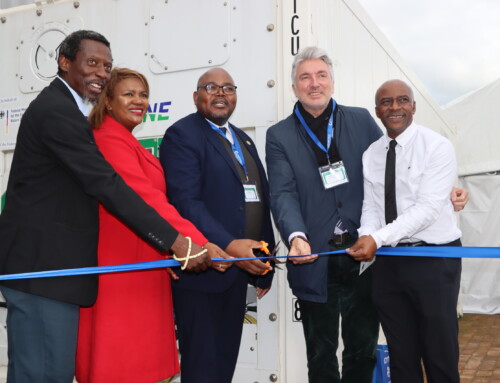
Atlantis – today Provincial Minister for Environmental Affairs and Development Planning, Anton Bredell, launched the Refrigeration and Air-Conditioning (RAC) Green Laboratory at the West Coast Technical Vocational Education and Training (TVET College), which is the first public TVET college in the Province to train students in the safe handling and use of natural refrigerant gases in the RAC sector.
The launch of the Laboratory directly links to the country’s commitments made on the Kigali Amendment of the Montreal Protocol, to phase down the consumption and use of hydrofluorocarbons, also known as HFCs.
At the opening ceremony Bredell stated that, “Most of the refrigeration and air conditioning applications currently use HFCs, as refrigerants. These powerful greenhouse gases have a high global warming potential, that are several thousand times more potent than natural refrigerant gases, and they can stay trapped in the atmosphere for centuries contributing to the global greenhouse effect.”
Thanks to a long-standing partnership between the Western Cape Government, the Bavarian Ministry of the Environment and Consumer Protection, the Bavarian Environment Agency, and the GIZ Proklima, the Western Cape RAC Project started in 2017, with the West Coast TVET College joining the project in 2019. Today marks the successful transition from “project concept-to-reality”, as we officially open the RAC Green Laboratory, as a sub-division of the West Coast TVET College’s RAC Training Centre.”
Current projections estimate that the demand for refrigeration and air conditioning will increase significantly as temperatures continue to rise, and projections are that the RAC Sector will contribute 13% of the greenhouse gas emissions in the world by 2030, without any serious interventions like these.
Principal of the West Coast College, Mr Lungisa Mbulawa said: “We, as an institution, are proud to be the first public TVET college to train RAC students in the use and safe handling of natural gases, which will contribute to the efforts as an industry to reduce greenhouse gas emissions, global warming and ultimately, climate change.”
A total of nine RAC students, who were trained as part of a pilot to trial the equipment in the RAC Green Laboratory prior to its officials opening today, received their certificates, which are also endorsed by two South African RAC Associations, viz. SARACCA and SAIRAC.
Bredell adds that South Africa has committed to an 83% phase-down of consumption and handling of HFCs by 2047, and it is within this commitment that the scope of the RAC Partnership Project and the RAC training at the West Coast TVET College lies.